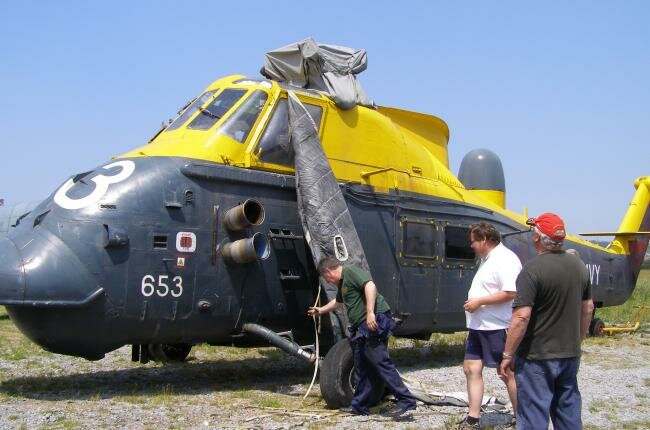
Wessex HAS.3 HistoryWestland Wessex, XM328, c/n WA9, was built at Yeovil in 1959 as a pre-production HAS.1 anti-submarine warfare helicopter for the Royal Navy, powered by one 1450 shp Napier Gazelle NGa.13 Mk.161 turboshaft engine. The HAS.1 was the world's first free-turbine engine aircraft to go into quantity production. It was fitted with dunking sonar, Doppler radar navigation, partial auto-stabilisation and Louis Newmark Mk.19 autopilot facilities. The new Flight Control System allowed the HAS.1 to hover over the sea at night or in bad visibility. Previously this could only be done when the pilot had a visual horizon as a reference.XM328 spent the first years of its life engaged in radio, instrument and other flight performance trials, including some at A & AEE Boscombe Down with ten other pre-production examples. |
||
| Wessex HAS.1, XM328, in 1960 . | XM328 after HAS.3 configuration upgrade. | |
| Between 1965 and 1968 forty-three HAS.1s, including XM328, were upgraded to Mk.3 specification. This included a new Ekco search radar in a dorsal dome, causing the type to be known as the 'Camel', and full Louis Newmark Mk 30 duplex flight control systems giving attitude and heading control with barometric or radio altimeter height hold. A new medium-depth Plessey Type 195 dipping sonar system was fitted while the 1600 shp Gazelle NGa.22 Mk 165 turboshaft engine replaced the Mk 161 . | ||
|
From 1970, XM328 was stationed at Portland, in Dorset, with 737 Naval Air Squadron where, as an HAS.3, it was assigned to operate, in an operational training role, from Helicopter Support Ship RFA Engadine and later, from the stern platforms of several of the six County Class guided missile destroyers, including HMS Glamorgan, HMS Antrim and HMS Norfolk. Wessex HAS.3s equipped seven flights on these destroyers in addition to an aircrew training squadron at RNAS Portland.
In their ship-borne, anti-submarine role, the HAS.3s could carry two Mk.44 or Mk.46 homing torpedoes (with parachutes) or four Mk.11 depth charges in addition to their Plessey dipping sonar. They could also be fitted with a door-mounted machine gun and act as a self-contained unit, handling all operations at the scene of an anti-submarine action. |
||
|
In 1984, after a short time in storage at Wroughton, XM328 was transferred to RNAS Culdrose, in Cornwall. There, for the next twenty years, it was used as a ground training aircraft, by the School of Aircraft Handling, (more recently, the School of Flight Deck Operations), which teaches the skills of moving and securing aircraft on flight decks and in hangars. XM328 as seen (right) at RNAS Culdrose in July 1997. |
|||
| In July 2003, XM328, re-painted in anti-submarine colour scheme, was loaned, by RNAS Culdrose, for display at the Royal International Air Tattoo, Fairford (above), but was declared surplus by the MoD, in early 2004, purchased by The Helicopter Museum, delivered by MASU in May 2004 and parked in the open air. Thanks for photographs (above left) © Stephen Boreham and (above right) © Ben Clements, both seen on Airliners.net |
|||
Restoration of the HAS.3 |
|||
| On 17th June 2006, after two years exposure to the weather, XM328 was brought into the main public Display Hangar (above) but, on 23rd June 2007, was transferred to the new engineering hangar area, not normally open to visitors, for conservation. However the HAS.3 could still be seen through the (normally open) hangar doorway, as work continued. | |||
| XM328 is largely complete although the instrument panel and a lot of the cockpit interior fittings were missing. Much of the cabin equipment survives, including some of the internal winch mechanism used for raising and lowering the sonar buoy. A rapid structural survey of the interior and exterior was carried out, in 2006, and the larger components of this cabin equipment were removed, for refurbishment and conservation, while the machine was still on public display in the main hangar. | |||
| Photographed in July 2006 (above left), before the cabin equipment was removed, the sonar buoy cable pulley is seen in the forward end of the cabin above the floor hatch. The remains of the sonar operator's and the tactical observer's console (above right), in the centre of the cabin and behind the sonar winch mechanism, retains the manual control handle (centre of photograph) for the buoy hoist. The vacant space to the left of the console was occupied by the radar display, the panel to the right by the sonar screens and controls. |
||
| Most of the autopilot, sonar and other avionics units, in the forward cabin racks, were labelled and removed in 2006, prior to cleaning and corrosion treatment. Following XM328's transfer to the newly-completed Engineering Hangar in 2007, most of the other cabin equipment was dismantled, though a control panel (above left) mounted above the console, and the radar operator's seat (above right), remained. | ||
| XM328 Restoration - Next Page (2) | ||
| Restoration Index | ||